
The Hidden Cost of Not Having a Knowledgebase for Your Operations Team

Kathy Prince

Your team is losing time and money every day without a centralized knowledgebase.
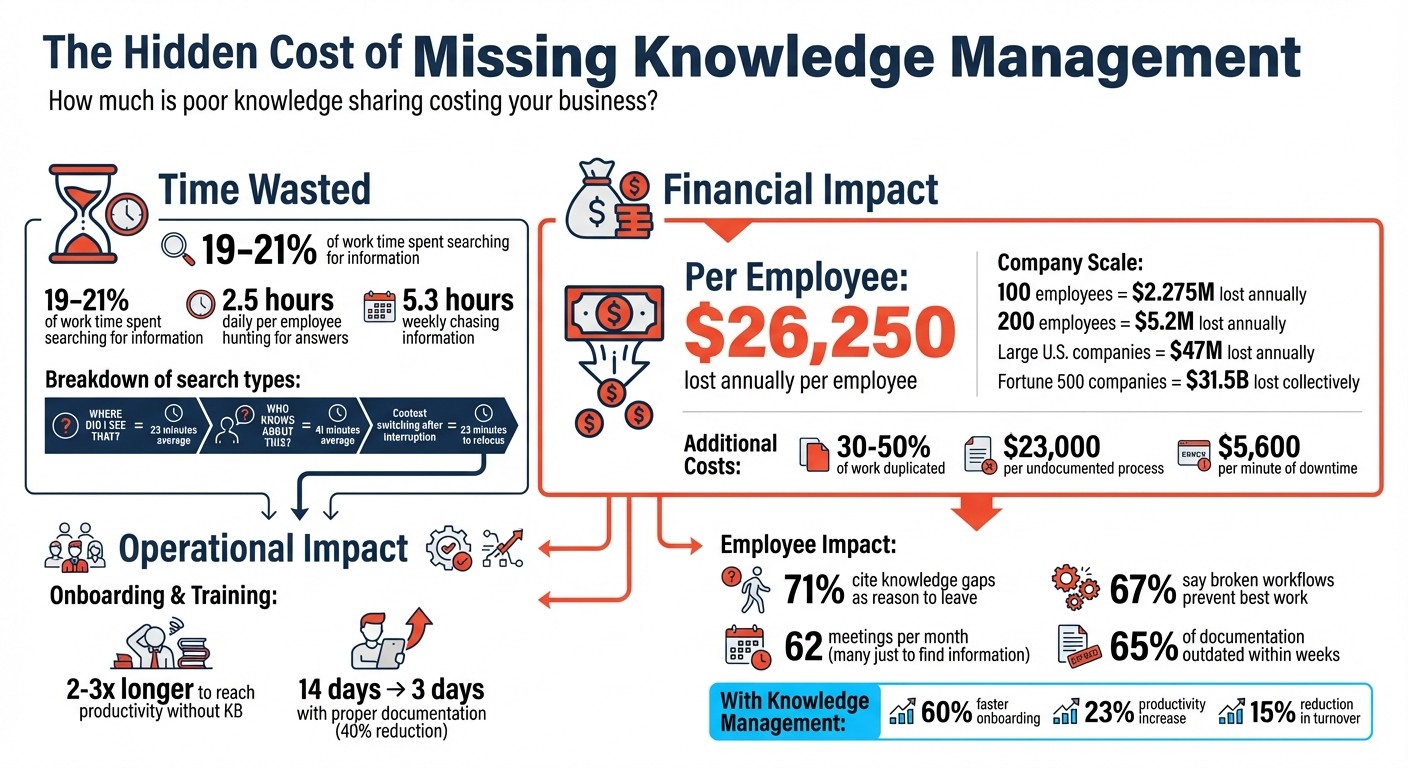
Here’s the problem: Employees spend 19% of their workweek - up to 5.3 hours - searching for internal information. This inefficiency costs companies $26,250 per employee annually. For businesses with 200 employees, that’s $5.2 million every year.
Beyond wasted time, knowledge silos, tool sprawl, and reliance on tribal knowledge lead to duplicated work, slower decision-making, and disruptions when key employees leave. Poor documentation also prolongs onboarding, wastes resources, and frustrates employees, driving turnover.
Key stats:
Large U.S. companies lose $47 million annually due to poor knowledge sharing.
Teams duplicate 30%-50% of work without leveraging existing solutions.
Downtime costs $5,600 per minute when problems take longer to resolve.
The solution? Tools like Rivulo simplify knowledge management with no-code interfaces, reducing onboarding time by 60% and boosting productivity by 23%. Without a knowledgebase, inefficiencies will keep draining resources and morale.
Financial Cost of Missing Knowledge Management Systems - Annual Impact on Business
The Financial Cost of Missing Knowledge Systems
Calculating Lost Revenue
When your operations team struggles to locate the information they need, the financial repercussions can pile up fast. On average, fragmented knowledge costs companies around $26,250 per employee every year due to wasted time on search and retrieval tasks. For a company with 200 employees, that adds up to a staggering $5.2 million annually.
Now, scale that to larger businesses, and the losses become even more jaw-dropping. Large U.S. companies lose an average of $47 million each year because of inefficient knowledge sharing. Fortune 500 companies collectively take an even bigger hit, forfeiting an estimated $31.5 billion annually due to poor information-sharing practices.
And it doesn’t stop there. Between 30% and 50% of work gets duplicated when teams fail to leverage existing solutions, wasting both time and resources. These inefficiencies create a ripple effect, leading to daily productivity drains that are hard to ignore.
Time Spent Searching for Information
The financial toll is further amplified by the sheer amount of time employees spend searching for the information they need. On average, employees devote 2.5 hours every day to this task, which accounts for 19% to 21% of their work time.
The type of search also impacts how much time gets wasted. For instance, trying to recall "Where did I see that?" typically takes 23 minutes, as employees sift through emails, multiple platforms, and repositories. Meanwhile, asking "Who knows about this?" stretches to an average of 41 minutes, thanks to interruptions, delays, and additional meetings.
For a company with 100 employees, this daily "information hunting" adds up to an annual cost of approximately $2.275 million. And that’s not all - when someone interrupts a colleague with a "quick question", it takes an average of 23 minutes for the interrupted employee to regain focus on their original task. These constant context switches create a compounding effect, draining productivity in ways that many organizations fail to measure.
How Missing Knowledge Disrupts Operations
Slower Problem Resolution and Decision-Making
When systems like Salesforce, Zendesk, NetSuite, and even personal notebooks don’t communicate, even answering simple questions can turn into a time-consuming task. These "Tool Silos" trap data in separate applications, forcing teams to manually piece together information to get a clear picture.
This lack of a unified source of truth slows decision-making. Teams often err on the side of caution, making slower or overly conservative choices. In some cases, they resort to repeating inspections just to avoid acting on incomplete data. When problems arise, technicians have to rely on physical inspections and verbal accounts to reconstruct system histories - an inefficient process that can significantly extend downtime. Given that downtime costs businesses an average of $5,600 per minute, these delays quickly add up.
Another challenge comes from "Individual Silos" - critical knowledge that exists only in the minds of specific employees. When these key individuals are unavailable or leave the company, operations can come to a standstill. Their absence often results in the loss of essential workarounds, leaving teams scrambling to fill the knowledge gaps.
Poor documentation further exacerbates the problem, forcing employees into unnecessary meetings. Without a centralized knowledgebase, workers attend an average of 62 meetings per month. Many of these meetings aren’t about collaboration but are simply attempts to fill information gaps that proper documentation could have easily addressed. These inefficiencies not only slow immediate problem-solving but also make it harder for new hires to get up to speed.
Longer Onboarding and Training Periods
Fragmented knowledge systems also make onboarding and training new employees a drawn-out process. Without centralized, organized information, new hires take 2–3 times longer to become fully productive.
A great example of overcoming this challenge comes from Woods Bagot, a global architectural and consulting firm. In January 2026, the company tackled their scattered documentation problem under the leadership of Michelle Van Kolck, Global Specialist-Design Technology. Using a no-code knowledgebase tool, they transformed disorganized information into actionable resources, including embedded videos and PDFs. This centralized approach not only boosted productivity but also reduced workplace interruptions by encouraging employees to find answers on their own.
"The rise in usage also suggests that people are relying less on seeking help from others and instead referring to the knowledge base for assistance."
Michelle Van Kolck, Global Specialist-Design Technology, Woods Bagot
The results speak volumes: effective documentation can cut new hire training time by 40% and reduce onboarding durations from 14 days to just 3 days. Without centralized knowledge, new employees waste valuable time searching for information, disrupting colleagues, and creating inefficient workarounds - all of which delay their path to productivity.
The Impact on Productivity and Employee Satisfaction
Repeated Work and Wasted Effort
When organizations lack a centralized knowledgebase, teams often find themselves solving the same problems over and over. One employee might spend hours researching a solution, unaware that a colleague has already done the exact same work. This duplication of effort is incredibly common - and costly. Studies show that 30% to 50% of work gets duplicated when teams fail to use existing solutions effectively.
Scattered information compounds the problem. Employees dig through emails, personal notes, or messaging platforms, often resorting to inefficient workarounds like scheduling extra meetings or manually re-entering data. These inefficiencies add up. Poor process documentation alone can cost organizations up to $23,000 per process annually.
"Poor KM is not just an operational oversight. It's a financial hemorrhage."
The issue becomes even more critical when experienced employees leave. Their unwritten knowledge - those shortcuts, workarounds, and insights - disappears with them. New hires often spend months rediscovering what could have been preserved in a centralized system. This not only wastes time but also undermines overall team productivity and morale.
Employee Frustration from Inaccessible Information
The inefficiencies of poor knowledge management don’t just waste time - they also take a toll on employee satisfaction. When employees can't easily access the information they need, stress levels rise, and job satisfaction plummets. The constant frustration of hitting dead ends or repeatedly asking for the same information can wear down even the most motivated team members.
Outdated documentation is a major culprit. 65% of documentation becomes outdated within weeks of being created. When employees lose trust in official systems, they stop relying on them altogether. Stuart Leo, Founder of Waymaker, captures this sentiment perfectly:
"The wiki becomes a graveyard of outdated information that nobody trusts."
Stuart Leo, Founder, Waymaker
This lack of trust and accessibility can have serious consequences. 71% of employees cite knowledge gaps as a factor in their decision to leave a job. On top of that, employees spend 5.3 hours each week chasing outdated or hard-to-find information, which contributes to burnout. Broken workflows and flawed processes also hold employees back, with 67% reporting that these issues prevent them from doing their best work.
The good news? Effective knowledge management can make a real difference. By ensuring employees have reliable access to the information they need, organizations can reduce turnover by 15%. When employees feel empowered with the right tools and information, they’re more autonomous, confident, and engaged. Instead of wasting time searching, they can focus on meaningful work, boosting both productivity and morale.
How Rivulo Addresses These Problems
Rivulo's Knowledge Management Capabilities
Rivulo makes it simple for non-technical operations teams to build and manage centralized knowledgebases without hassle. Thanks to its no-code interface, your team can dive right into documenting processes - no need for developer involvement or complex training.
One of its standout features is screen-sharing documentation. Instead of typing out lengthy instructions, employees can record themselves performing tasks while explaining the steps. Rivulo’s AI then transforms these recordings into polished standard operating procedures (SOPs). A great example? In 2026, a medium-sized accounting firm documented 40 financial reporting procedures for a compliance audit in less than 50 hours. That’s a 75% time savings compared to the 200 hours they had originally budgeted.
This streamlined approach eliminates the "documentation graveyard" problem. When creating SOPs is quick and easy, teams are more likely to keep them updated. Rivulo also offers browser automation tools, handling repetitive tasks that often slow down operations teams. This frees up your staff to focus on more meaningful work while ensuring consistency across processes. The result? Improved efficiency and noticeable performance gains.
Measuring Results with Rivulo
The benefits of Rivulo are clear when you look at the numbers. For instance, a financial services firm cut their average onboarding time from 10 days to just 4 days, saving roughly $2,500 per new hire in trainer hours and increased productivity. Similarly, a software company saw a 25% drop in Level 1 support ticket volume within six months, while resolution times for common issues decreased from 45 minutes to just 15 minutes.
Metric | Before Rivulo | After Rivulo |
|---|---|---|
Onboarding Time | 10–14 Days | 3–4 Days |
Documentation Creation (40 SOPs) | 200 Hours | <50 Hours |
Time Spent Searching Daily | 1.8–2.0 Hours | ~0.9–1.0 Hours |
Support Resolution Time | 45 Minutes | 15 Minutes |
Overall Productivity | Baseline | +23% Increase |
One standout case involved a manufacturing client who reduced their assembly line defect rate from 3% to 1.5% by using Rivulo to provide accessible SOPs. This improvement alone saved the company $80,000 annually in reduced waste. When employees have access to accurate, up-to-date information, they make fewer mistakes and work more effectively - results that directly benefit your bottom line.
What is Knowledge Operations?
Conclusion
A lack of a centralized knowledgebase comes with a hefty price tag - $26,250 per employee annually in wasted productivity. For Fortune 500 companies, the stakes are even higher, with inefficient knowledge sharing draining an estimated $31.5 billion every year. These numbers represent more than just financial losses; they highlight inefficiencies that ripple across daily operations.
When teams lack access to the right information, decision-making slows down, and reliance on outdated or informal "tribal" knowledge leads to costly errors. This issue becomes especially problematic when key employees leave, taking their expertise with them. As Kent Hansen from Centric Consulting points out, "Companies with strong operational efficiency achieve 25 percent higher growth and 75 percent higher productivity than competitors".
Rivulo offers a way out of this cycle. By simplifying knowledge capture with its no-code interface and screen-sharing tools, Rivulo reduces onboarding times and helps businesses achieve productivity gains of 23% or more.
The question is: Can you afford to keep losing time, frustrating employees, and missing opportunities without a centralized knowledgebase? The solution is easier to implement than ever, and the benefits could start appearing in just weeks.
FAQs
What should an operations knowledgebase include first?
An operations knowledge base should focus on company policies, standard operating procedures (SOPs), and training materials as its core components. These resources are the backbone of operational consistency, helping to simplify workflows and improve team productivity. By prioritizing these elements, you create a centralized hub that minimizes confusion and gives employees clear guidance for handling daily responsibilities and making informed decisions.
How do I calculate the ROI of a knowledgebase for my team?
To figure out the ROI of a knowledge base, you’ll need to weigh its costs against the benefits it brings. Start with the implementation costs, but don’t stop there - factor in the potential advantages, like saving time and boosting productivity.
For example, if employees spend 20% of their time hunting for information, cutting that down by 35% could lead to major savings on labor costs each year. Beyond that, consider how a knowledge base might reduce errors or speed up onboarding for new team members. Add up the savings from these areas and compare them to the total costs of the knowledge base to get a clear picture of its ROI.
How do we keep SOPs updated without extra overhead?
Keeping Standard Operating Procedures (SOPs) up-to-date doesn't have to be a hassle. The key is using a centralized, well-maintained knowledge base. This approach simplifies the process and ensures everyone has access to the latest information.
To keep things running smoothly, assign clear ownership of each SOP. This way, someone is always responsible for updates. Automating review reminders can also save time and ensure nothing slips through the cracks. Make editing straightforward by implementing tools with version control, so changes are tracked and managed easily.
Finally, include a way for team members to provide feedback. This helps identify outdated or inaccurate content quickly, keeping SOPs relevant and reducing workflow disruptions caused by inefficiencies.
Related Blog Posts

Hand over your first workflow this week
Hand Rivulo your most tedious workflow or your team’s most-asked question. Either way, it starts by understanding how your business works, and then it takes care of the rest.